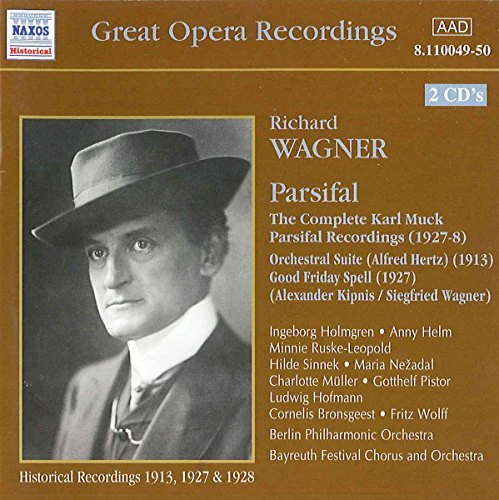
Richard Wagner - Wagner: Parsifal (highlights) [CD]
All items shipped within 3 working days of payment.
Please note that all our DVDs are Region 2.
Please note that not all audio CDs are shrink-wrapped fom the factory.
Alfred Hertz's 1913 recording of 37 minutes' worth of excerpts from Parsifal was one of the more ambitious orchestral recording projects of the acoustic era. In those days before microphones were developed for electrical recording, musicians gathered in small studios, crowded around a gigantic horn into which they would play. Balances were determined by seating proximity to the horn. Even then, some types of instruments (e.g. the brass) registered more clearly than others (the strings). In the present recording, there appears to be little of the re-orchestration which was commonly undertaken during this period in an attempt to bolster the less-phonogenic sections of the orchestra, (by, for example, reinforcing the bass line with tubas). As a result, we are able to hear the Berlin Philharmonic in much the way it would have sounded in concert, albeit through a sonic glass darkly. The 1927 Bayreuth Festival recordings were made two years after the adoption of electrical recording as the industry standard enabled itinerant engineers to set up microphones in any concert hall in the world - even the fabled Festspielhaus itself. The original recordings were far from flawless, even by the standards of the time; yet Karl Muck's high fees precluded the Columbia engineers from remaking several sides which were excessively overcut. Artist fees were also cited as the reason for recording the \\Grail Scene without a Titurel or an Amfortas, and the 'Flower Maidens Scene' without Parsifal. However, what we miss there is more than made up for by the presence of the original Bayreuth bells in the Act I Transformation Scene. Cast for the first production of the opera in 1882, they were melted down for the German war effort in the early 1940s. Their imposing sound (notably tuned to a lower pitch than the orchestra was using by the late 1920s) would have vanished forever from the earth, had it not been preserved for posterity in shellac grooves. The finest vintages of source material were used for these transfers. The Hertz discs came from Hanover 'Gramophone Concert Record' pressings, the Muck First Act Prelude and all of Act III were transferred from Victor 'Z' pressings; and the 1927 Bayreuth Festival recordings came from a combination of U.S. Columbia 'Viva-Tonal' and laminated, pre-EMI English Columbia copies, with the best sides from each being used. Although Ceder-2 declicking was employed, some low-frequency thumps caused by pressing bubbles remain in portions of the rare Hertz recording. ''
Parsifal: Orchestral Suite: Prelude To Act 1
Parsifal: Act II: Flower Maidens Scene
Parsifal: Act I Transformation Music
Parsifal: Act III: Prelude
Parsifal: Act III Transformation Music
Parsifal: 'Heil mir, dass ich dich wieder finde!'
Parsifal: Good Friday Spell
Parsifal: 'O Gnade! Hochstes Heil!'
Parsifal: Act I: Prelude To Act I
Parsifal: 'So ward es uns verhiessen' - Good Friday Spell
Parsifal: Transformation Music
Parsifal: 'Mittag: die Stund' ist da' - Transformation Music
Parsifal: Grail Scene: 'Zum letzten Liebesmahle'
Parsifal: 'Geleiten wir im bergenden Schrein'
Parsifal: 'Durch Mitleid wissend, der reine Tor'
Parsifal: 'Ja, Wehe! Wehe!'
Parsifal: 'Wein und Brot des letzten Mahles'
Parsifal: 'Nur eine Waffe taugt'
Parsifal: 'So ward es uns verhiessen' - Good Friday Spell
Product Information
Product Information
Shipping & Returns
Shipping & Returns
Description
All items shipped within 3 working days of payment.
Please note that all our DVDs are Region 2.
Please note that not all audio CDs are shrink-wrapped fom the factory.
Alfred Hertz's 1913 recording of 37 minutes' worth of excerpts from Parsifal was one of the more ambitious orchestral recording projects of the acoustic era. In those days before microphones were developed for electrical recording, musicians gathered in small studios, crowded around a gigantic horn into which they would play. Balances were determined by seating proximity to the horn. Even then, some types of instruments (e.g. the brass) registered more clearly than others (the strings). In the present recording, there appears to be little of the re-orchestration which was commonly undertaken during this period in an attempt to bolster the less-phonogenic sections of the orchestra, (by, for example, reinforcing the bass line with tubas). As a result, we are able to hear the Berlin Philharmonic in much the way it would have sounded in concert, albeit through a sonic glass darkly. The 1927 Bayreuth Festival recordings were made two years after the adoption of electrical recording as the industry standard enabled itinerant engineers to set up microphones in any concert hall in the world - even the fabled Festspielhaus itself. The original recordings were far from flawless, even by the standards of the time; yet Karl Muck's high fees precluded the Columbia engineers from remaking several sides which were excessively overcut. Artist fees were also cited as the reason for recording the \\Grail Scene without a Titurel or an Amfortas, and the 'Flower Maidens Scene' without Parsifal. However, what we miss there is more than made up for by the presence of the original Bayreuth bells in the Act I Transformation Scene. Cast for the first production of the opera in 1882, they were melted down for the German war effort in the early 1940s. Their imposing sound (notably tuned to a lower pitch than the orchestra was using by the late 1920s) would have vanished forever from the earth, had it not been preserved for posterity in shellac grooves. The finest vintages of source material were used for these transfers. The Hertz discs came from Hanover 'Gramophone Concert Record' pressings, the Muck First Act Prelude and all of Act III were transferred from Victor 'Z' pressings; and the 1927 Bayreuth Festival recordings came from a combination of U.S. Columbia 'Viva-Tonal' and laminated, pre-EMI English Columbia copies, with the best sides from each being used. Although Ceder-2 declicking was employed, some low-frequency thumps caused by pressing bubbles remain in portions of the rare Hertz recording. ''
Parsifal: Orchestral Suite: Prelude To Act 1
Parsifal: Act II: Flower Maidens Scene
Parsifal: Act I Transformation Music
Parsifal: Act III: Prelude
Parsifal: Act III Transformation Music
Parsifal: 'Heil mir, dass ich dich wieder finde!'
Parsifal: Good Friday Spell
Parsifal: 'O Gnade! Hochstes Heil!'
Parsifal: Act I: Prelude To Act I
Parsifal: 'So ward es uns verhiessen' - Good Friday Spell
Parsifal: Transformation Music
Parsifal: 'Mittag: die Stund' ist da' - Transformation Music
Parsifal: Grail Scene: 'Zum letzten Liebesmahle'
Parsifal: 'Geleiten wir im bergenden Schrein'
Parsifal: 'Durch Mitleid wissend, der reine Tor'
Parsifal: 'Ja, Wehe! Wehe!'
Parsifal: 'Wein und Brot des letzten Mahles'
Parsifal: 'Nur eine Waffe taugt'
Parsifal: 'So ward es uns verhiessen' - Good Friday Spell