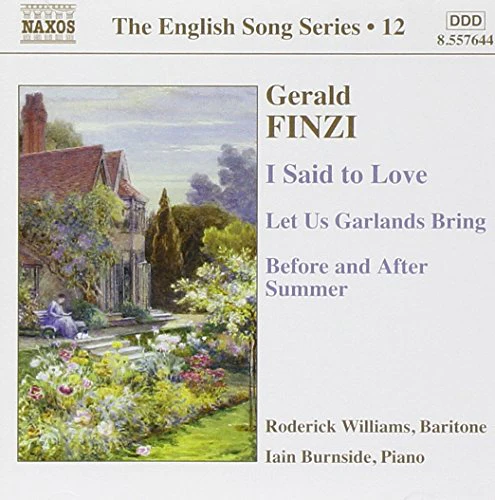
Williamsburnside - Gerald Finzi: I Said to Love / Let Us Garlands Bring / Before and After Summer [CD]
All items shipped within 3 working days of payment.
Please note that all our DVDs are Region 2.
Please note that not all audio CDs are shrink-wrapped fom the factory.
Gerald Finzi (1901-1956)I Said to Love, Op. 19bLet Us Garlands Bring, Op. 18Before and After Summer, Op. 16Gerald Finzi studied with Ernest Farrar, EdwardBairstow and R.O. Morris. He came to attention withworks like the orchestral miniature A Severn Rhapsody(1923) and a song-cycle to poems by Thomas Hardy,By Footpath and Stile (1921-2). Finzi's reputationgrew during the 1930s with performances of twogroups of Hardy settings, A Young Man's Exhortation(1926-9) and Earth and Air and Rain (1928-32), andwas consolidated with the premi?\xbfre in 1940 of hiscantata Dies natalis (1925-39). During World War IIFinzi worked at the Ministry of War Transport andfounded a fine, mainly amateur, orchestra, theNewbury String Players. Two of his most popularworks appeared during the war, the Five Bagatelles forclarinet (1920s, 1941-3) and the Shakespeare settings,Let Us Garlands Bring (1938-40).In the post-war years his works include the festivalanthem Lo, the Full, Final Sacrifice (1946), theceremonial ode For St Cecilia (1947) and a furtherHardy song set Before and After Summer (1932-49),the Clarinet Concerto (1948-9) and Intimations ofImmortality for chorus and orchestra (late 1936-8,1949-50). Although the final years of his life werelived under the shadow of an incurable illness, hecompleted the Christmas scene In terra pax (1951-4)and his Cello Concerto (1951-5).Song-writing is at the heart of Finzi's output andhe made a significant contribution to British twentiethcenturymusic in this genre, especially the settings ofThomas Hardy, his favourite poet, whom he set morethan any other. His volume of Hardy's CollectedPoems was a treasured possession, as he wrote to afriend: 'If I had to be cut off from everything thatwould be the one book I should choose'. He felt anempathy with Hardy's bleak fatalism, his sense oftransience, and his anger at the suffering that mankindafflicts on mankind. About Hardy he wrote tellingly: 'Ihave always loved him so much and from earliest daysresponded, not so much to an influence, as to a kinshipwith him'.Finzi composed slowly, so that songs that formedhis sets, as he preferred to call them, were gatheredover many years, gradually being brought into suitablegroupings. Consequently at his death some two dozensongs were left complete. His friend HowardFerguson, together with Finzi's widow Joy, and eldestson Christopher, divided them into four song sets ofwhich I Said to Love brought together the remainingHardy settings for baritone. This group includes foursongs that Finzi, in a flurry of creativity, composed orcompleted during 1956, the last year of his life, withothers begun in the 1920s. Ferguson accompaniedJohn Carol Case in the first performance of the songson 27th January the following year.Initially the setting of I Need Not Go has anonchalant air, but in the final verse the music changesmood with the realisation that the poet's beloved is, inreality, in her grave. The damp chill of a murkywinter's day is evoked by Finzi in At Mi
I Need Not Go
At Middle-Field Gate In Febuary
Two Lips
In Five-Score Summers (Mediation)
For Life I Had Never Cared Greatly
I Said To Love
Come Away, Come Away, Death
Who Is Silvia?
Fear No More The Heat O' The Sun
O Mistress Mine
It Was A Lover And His Lass
Childhood Among The Ferns
Before And After Summer
The Self-Unseeing
Overlooking The River
Channel Firing
In The Mind's Eye
The Too Short Time
Epeisodia
Amabel
He Abjures Love
Original: $320.00
-70%$320.00
$96.00Product Information
Product Information
Shipping & Returns
Shipping & Returns
Description
All items shipped within 3 working days of payment.
Please note that all our DVDs are Region 2.
Please note that not all audio CDs are shrink-wrapped fom the factory.
Gerald Finzi (1901-1956)I Said to Love, Op. 19bLet Us Garlands Bring, Op. 18Before and After Summer, Op. 16Gerald Finzi studied with Ernest Farrar, EdwardBairstow and R.O. Morris. He came to attention withworks like the orchestral miniature A Severn Rhapsody(1923) and a song-cycle to poems by Thomas Hardy,By Footpath and Stile (1921-2). Finzi's reputationgrew during the 1930s with performances of twogroups of Hardy settings, A Young Man's Exhortation(1926-9) and Earth and Air and Rain (1928-32), andwas consolidated with the premi?\xbfre in 1940 of hiscantata Dies natalis (1925-39). During World War IIFinzi worked at the Ministry of War Transport andfounded a fine, mainly amateur, orchestra, theNewbury String Players. Two of his most popularworks appeared during the war, the Five Bagatelles forclarinet (1920s, 1941-3) and the Shakespeare settings,Let Us Garlands Bring (1938-40).In the post-war years his works include the festivalanthem Lo, the Full, Final Sacrifice (1946), theceremonial ode For St Cecilia (1947) and a furtherHardy song set Before and After Summer (1932-49),the Clarinet Concerto (1948-9) and Intimations ofImmortality for chorus and orchestra (late 1936-8,1949-50). Although the final years of his life werelived under the shadow of an incurable illness, hecompleted the Christmas scene In terra pax (1951-4)and his Cello Concerto (1951-5).Song-writing is at the heart of Finzi's output andhe made a significant contribution to British twentiethcenturymusic in this genre, especially the settings ofThomas Hardy, his favourite poet, whom he set morethan any other. His volume of Hardy's CollectedPoems was a treasured possession, as he wrote to afriend: 'If I had to be cut off from everything thatwould be the one book I should choose'. He felt anempathy with Hardy's bleak fatalism, his sense oftransience, and his anger at the suffering that mankindafflicts on mankind. About Hardy he wrote tellingly: 'Ihave always loved him so much and from earliest daysresponded, not so much to an influence, as to a kinshipwith him'.Finzi composed slowly, so that songs that formedhis sets, as he preferred to call them, were gatheredover many years, gradually being brought into suitablegroupings. Consequently at his death some two dozensongs were left complete. His friend HowardFerguson, together with Finzi's widow Joy, and eldestson Christopher, divided them into four song sets ofwhich I Said to Love brought together the remainingHardy settings for baritone. This group includes foursongs that Finzi, in a flurry of creativity, composed orcompleted during 1956, the last year of his life, withothers begun in the 1920s. Ferguson accompaniedJohn Carol Case in the first performance of the songson 27th January the following year.Initially the setting of I Need Not Go has anonchalant air, but in the final verse the music changesmood with the realisation that the poet's beloved is, inreality, in her grave. The damp chill of a murkywinter's day is evoked by Finzi in At Mi
I Need Not Go
At Middle-Field Gate In Febuary
Two Lips
In Five-Score Summers (Mediation)
For Life I Had Never Cared Greatly
I Said To Love
Come Away, Come Away, Death
Who Is Silvia?
Fear No More The Heat O' The Sun
O Mistress Mine
It Was A Lover And His Lass
Childhood Among The Ferns
Before And After Summer
The Self-Unseeing
Overlooking The River
Channel Firing
In The Mind's Eye
The Too Short Time
Epeisodia
Amabel
He Abjures Love